
It should announce its candidates 45 days before the elections; trust rooted leaders; start its campaign focused on five guarantees six months before elections.
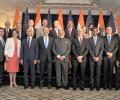
Prime Minister Narendra D Modi's itinerary for his June 21-24 US visit could include an address to a fledgling business advocacy group, the US-India Strategic Partnership Forum.
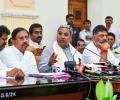
'Karnataka's finances are much healthier than the Union government's, which is indebted to nearly twice the extent of the state.'

Both the BJP and Congress understand that coalitions and alliances are not just about numbers, but have symbolic value.

The BJP's challenge is whether it can again deflate a Congress, which now looks reinvigorated and has adopted sharper messaging around its 'guarantees', and several regional parties, especially in Bihar, Maharashtra and West Bengal.

With Lok Sabha elections months away, the visits are vital politically as these would showcase Modi's standing as a world leader to the home electorate.
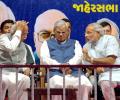
'It is not just about numbers. Sometimes coalitions and alliances have symbolic value.'

It's always been a struggle for economists and statisticians to forecast India's gross domestic product (GDP) correctly, and say where the economy is headed before the official numbers come out. If estimating the GDP is tough, forecasting it in real time is complicated. It involves looking at tens of indicators, such as industrial production, electricity consumption and exports, to arrive at a number.

There's no place like home, but even for the affluent buying one in India is difficult. On top of that, the coronavirus pandemic-now in its eighteenth month-has made life uncertain. A hopeful thing is buying a house looks alluring as loan interest rates fall below 7 per cent, their multi-decadal lows. The slow decline in GDP growth after demonetisation, followed by the economic shock caused by Covid-19 waves, has hurt us unevenly.
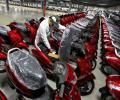
Retail sales of cars are back to January 2018 levels in August 2021. Two-wheeler retail sales are 22 per cent lower, nearly four years down the line.

It emerges that Vi has probably offered good data quality despite being short on spectrum and infrastructure due to its stretched finances. Did the two companies that merged face the heat due to price wars? Probably. Did the government's tough stance in demanding its "due" share of telecom revenues hurt the company? Certainly!
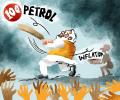
An average Indian spends no more than Rs 1.3 lakh per year, according to official statistics. This is close to what an average Indian earns annually. At this level of per capita income today, one litre of petrol costs one-third of an average Indian's daily income (Delhi prices), making it highly unaffordable. People in most other Asian and emerging countries find it more affordable.

India has placed orders for 786 million doses till date -- less than the probable need of 950 million doses, reports Abhishek Waghmare.
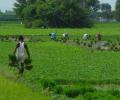
About 150 years ago, in British India, big farmers in the western region of Maharashtra agitated over unfair lending practices and demanded a more fair and inclusive financing structure. People say this is where the seeds of the cooperative movement, now omnipresent in the country, were sown. Today, more than 800,000 cooperative societies thrive in India, with 300 million members, a number close to the population of the United States. Despite a reach this deep--grass roots as they call it--cooperatives do not occupy a lion's share in the Indian economy.

Whenever the Census operation resumes, it will capture the impact of Covid-19 to a large extent, including the extra-lethal second wave, reports Abhishek Waghmare.

The average rate of COVID-19 vaccination in the country has been 10.8 million per week. At that rate, it will take India till December 2024 to complete two billion doses.

This will cost the government Rs 3.1 trillion, about 10 per cent of its annual expenditure, and higher than any other spending item in its Budget.

As India begins vaccinating the younger population, the most vulnerable remain largely unvaccinated.
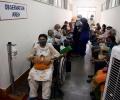
UP Rs 50 billion, followed by Maharashtra, Bihar, and West Bengal which may need close to Rs 25 billion for the massive task.
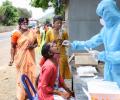
Three of the four major states delayed testing despite worsening indicators. Only Tamil Nadu quickened the pace after the first signs of deterioration.
 © 2026 Rediff.com - Investor Information - Advertise with us - Disclaimer - Privacy Policy - Sitemap - Feedback - About us - Terms of use - Grievances